Picture this: You are driving home from work, the kids are in the backseat, and the monthly mortgage payment is on your mind. A sudden stop, a fender bender. It seems minor, but then the other driver claims an injury. In that moment, the numbers on your insurance card aren’t just numbers—they are the thin line between a manageable hiccup and a financial avalanche that could wipe out your savings, your home, and the future you are building for your family. This is the reality of minimum insurance coverage. It is not a boring legal checkbox; it is the foundation of your financial security on the road, and it changes dramatically depending on where you live.
Here is where things get tricky. Every state sets its own rules, its own minimum liability limits. Think of it like the building code for a house. In Florida, the code might require a certain strength to withstand hurricanes,while in California, it is all about earthquakes. Your car insurance is the same. The state minimum is the absolute weakest structure the law says you can legally build your financial protection upon. But is the legal minimum enough to protect your family? Almost never.
Let us break down what these numbers mean. You will see them written as something like 25/50/25. This is not a secret code. It is a story of consequences.
The First Number (e.g., 25): This is the maximum, in thousands, your policy will pay for bodily injury to one person in an accident you cause. $25,000. Sounds okay, right? But here is the catch: a single trip to the emergency room for a broken arm can easily cost $15,000. Add in follow-up care, physical therapy, and lost wages for the other driver, and you have blown past that limit in a heartbeat. Once that $25,000 is gone, you are personally responsible for every single dollar above it.
The Second Number (e.g., 50): This is the total limit for all injuries in one accident. $50,000. If you cause an accident that injures two people, your policy will only pay up to $50,000 combined. With modern medical costs, that is a dangerously low ceiling. Your assets—your savings, your home—are now on the line to cover the gap.
The Third Number (e.g., 25): This is for property damage. $25,000 to fix or replace the other person’s car. Have you seen the price of a new pickup truck or an SUV? $25,000 might not even cover half of it. If you hit a luxury car or, worse, a commercial vehicle, you could be facing a bill for tens of thousands of dollars out of your own pocket.
Now, let us look across the map. The differences are stark and tell a story of local risk.
In Florida, a no-fault state, the focus is on Personal Injury Protection (PIP). The minimum is $10,000 in PIP and $10,000 in Property Damage Liability. That is it. No required bodily injury liability at all if you have PIP. This can feel like a trap. If you are at fault in a serious accident, that $10,000 for property damage vanishes instantly, and you have no required coverage for the other person’s medical bills beyond your PIP. You are exposed.

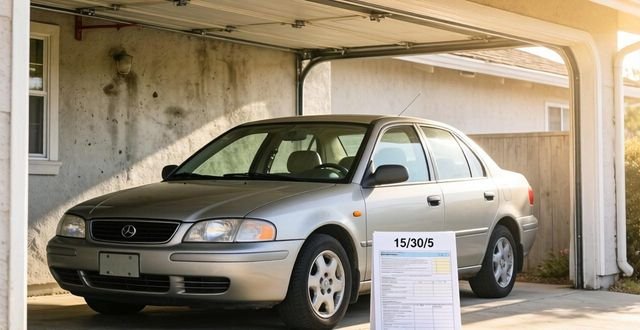
Jump to California, and the minimum is 15/30/5. Yes, only $5,000 for property damage—a standard set decades ago. In today’s world, $5,000 is often less than the deductible on the other driver’s policy. You are effectively underinsured from the moment you sign up.
Contrast that with Alaska or Maine, where minimums are 50/100/25. They recognize the higher potential costs and risks. It is like building a house in a snowier climate; you need a stronger roof.
But there is a massive, common mistake I see every day: “I just get the cheapest to be legal.” This mindset is a direct path to financial ruin. The state minimum is designed to offer some protection to the other party, not to protect you. It does not cover your own car’s repairs (that is collision coverage), your own medical bills in an at-fault accident (that is MedPay or health insurance), or a thousand other scenarios. Relying on it is like wearing a paper helmet on a construction site because it is the “minimum required” head covering. It might technically check a box, but it provides zero real safety.
So, what do you do? The action is not complicated, but it is vital.
1. Know Your State’s Numbers. Look them up. But then immediately move to step two.
2. Forget the Minimum. Think about your personal “Financial Fall Zone.” What do you own that you could lose? Your savings account? The equity in your home? Your future earnings through a lawsuit? Your liability coverage should be high enough to protect those assets. For most families, I recommend considering limits of at least 100/300/100 as a starting point for a true safety net.
3. Talk to an Independent Agent. This is key. We are not tied to one company. We can shop multiple carriers—like Guardian, Principal, or Mutual of Omaha—and show you how increasing your liability limits often costs far less than you think. Sometimes doubling your coverage only increases your premium by 10-15%. It is the most cost-effective financial protection you can buy.
The anxiety of a potential lawsuit, the fear of losing what you have worked so hard for—that feeling is real. The peace of mind that comes from knowing you have a robust shield between your life and the unexpected? That is priceless. Do not let a line on your insurance card be the deciding factor in your family’s financial future. Look beyond the minimum. Build your coverage to protect what actually matters.